pub

samedi 3 février 2018

Estudiar en Estados Unidos: Una perspectiva de América Latina

by


Estudiar en Estados Unidos: Una perspectiva de América Latina (full episode)


¿Eres estudiante o padre de un estudiante de América Latina que se pregunta cómo es realmente estudiar en una universidad en Estados Unidos? En ese caso, ¡Este charla virtual interactiva de EducationUSA de EducationUSA es para ti! Únete a expertos en educación superior que representan a colegios universitarios y universidades estadounidenses con programas de dos y cuatro años, estudiantes latinoamericanos matriculados en la actualidad, y un funcionario del Departamento de Estado de Estados Unidos para participar en un seminario interactivo de EducationUSA sobre la vida académica y universitaria diarias tal y como las experimentan estudiantes universitarios de América Latina en Estados Unidos. Haz preguntas y conoce lo que están haciendo los recintos universitarios de Estados Unidos para dar la bienvenida a estudiantes latinoamericanos e internacionales. Alfred Boll, EducationUSA, U.S. Department of State Gerardo Alan Mendoza Sosa (“Alan”), Student at Brown University (Class of 2020) Dr. Gabriela Polit, Profesora Asociada, Departamento de Español y Portugués, Universidad de Texas en Austin Yosimi Mitsuta, Student, University of Texas at Austin William Velez, Assistant Director of International Admissions and Recruitment and Chair of Study Oregon Consortia, Chemeketa Community College Juan Diego Quintero, Student, Chemeketa Community College

EducationUSA Interactive: U.S. Campus Culture (Full episode)

by


EducationUSA Interactive: U.S. Campus Culture (Full episode)

 
EducationUSA Interactive: U.S. Campus Culture (Full episode)Curious about studying in the U.S.? Already accepted and starting to pack? Either way, this EducationUSA Interactive is for you! Join U.S. higher education experts, currently enrolled international students, and a U.S. Department of State official for an introduction to U.S. academic culture and campus life. Find out what daily student life is like for international students studying in the U.S. today. Ask questions and learn how U.S. campuses welcome international students. Learn about: · Campus safety · Classroom Expectations: academic integrity and plagiarism; critical thinking; academic writing · Extracurricular activities and volunteering · Dorm life and social life Moderator: Fred Boll, EducationUSA, Department of State Guests: Alina Pak, Student from Russia; Shaun Ee, Student from Singapore; Michael Wilhelm, Associate Vice Chancellor, International Programs, University of North Carolina Wilmington; Emily Markham, Assistant Director of Global Engagement, LaRoche College

EducationUSA | Finance Your Studies (September 2017)

by
EducationUSA | Finance Your Studies (September 2017)
Are you interested in studying in the U.S. but unsure if you can afford it? Costs may seem prohibitive, but there are many avenues to financing an education at any U.S. college or university. This EducationUSA Interactive webinar has answers! Moderator: Alfred Boll, EducationUSA, U.S. Department of State. Speakers: Luiz Fernando (Brazil), Ph.D Student, Catholic University of America; Elaine Pawlik, International Student Services Coordinator & Counselor, University of the District of Columbia; Gwen Thomas, author, educator, advocate.

ducation USA helps U.S. higher education professionals

by
ducation USA helps U.S. higher education professionals connect with international students and engage with the U.S. government as well as foreign institutions and governments.
Request a login to access resources including 170 country fact sheets and the annual EducationUSA Global Guide. With a login you can also submit financial aid opportunities and campus news stories to raise awareness of your institution.

EducationUSA Forum:

Save the Date for Forum 2018!
Group of young adults shaking hands

Host EducationUSA Advisers on Your Campus!

Bring the world to your campus! In 2018, there will be opportunities to host advisers during EducationUSA Training Institutes and campus visits before or after conferences including the annual EducationUSA Forum in Washington, DC.
South and central asia

Attend the EducationUSA South and Central Asia Regional Forum

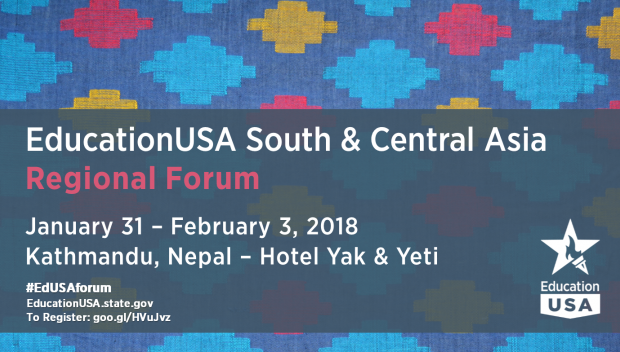
The EducationUSA network will host the EducationUSA South and Central Asia (SCA) Regional Forum January 31 - February 3, 2018 in Kathmandu, Nepal. Regional forums provide opportunities for representatives of U.S. institutions of higher education to convene and share strategies for increasing the recruitment and retention of international students on U.S. campuses.

vendredi 2 février 2018

The U.S. Educational System

by

The U.S. Educational System


One of the most attractive features of the U.S. higher education system is the flexibility it provides through the number and diversity of institution types it encompasses. 
This diversity offers students options to specialize in a variety of academic disciplines and even gain employment training.
More than 4,500 accredited institutions make up U.S. higher education in the United States. Unlike many countries, U.S. higher education institutions are not centrally organized or managed, but are accredited on a national or regional level by independent accrediting bodies.
A variety of institution types offer higher-education degrees. Liberal arts institutions, for example, offer courses in the arts, humanities, languages, and social and physical sciences. The majority of liberal arts institutions are private. Private colleges and universities are funded by a combination of endowments, gifts from alumni, research grants, and tuition fees. Private colleges and universities are usually smaller than public institutions and can have a religious affiliation or be single-sex schools.
Not sure what certain U.S. higher education words mean? Click here for definitions.

Community colleges are another option and provide two-year associate degree programs to prepare students to continue studies for an undergraduate degree or help them gain occupational skills for immediate employment. State colleges and universities, also called "public universities," were founded and subsidized by U.S. state governments to provide a low-cost education to residents of that state. Public universities generally offer access to research opportunities and classes in a wide variety of fields of study. These universities tend to be very large and generally admit a wider range of students than private universities. Each student's interests will guide his/her choice among the many possibilities.
Regardless of the institution type, in the United States, students typically earn credits for courses they take and these credits count towards the completion of a program. Courses are often divided into "core" subject areas to provide the foundation of the degree program and "major" courses to provide specialization in a subject area. Students can also take "elective" courses to explore other topics of interest for a well-rounded educational experience.
The U.S. academic calendar typically runs from September to May and can be divided into two academic terms of 16-18 weeks known as semesters. Alternatively, some schools may operate on a quarter or trimester system of multiple terms of 10-12 weeks.
With the variety of available U.S. higher education options, students are sure to find the right fit for their academic, financial, and personal needs.

mardi 30 janvier 2018

Finance Your Studies

by
Invest in yourself! The cost of living and studying varies across the United States. With the right amount of planning and research, pursuing a U.S. higher education can be made affordable with high returns on your investment.


              In Need of Funding? Find Financial Aid
Start your financial planning as early as possible. Each year international students receive significant amounts of financial assistance for their studies. However, competition is high. Applications for financial aid go together with applications for admission.
When looking into studying in the United States, evaluating your finances should be one of the first things you do. As with any investment, you need to evaluate what's best for your educational and career goals and what you are willing to spend.
U.S. institutions offer a wide array of programs with a wide array of tuition and fees. The United States is a large country and the cost of living varies greatly from place to place. You need to assess your funding and what you are able to spend on your education and living expenses.
Choose your level of study (community college, undergraduate, graduate, short-term, English language)  to learn more about financing your options.

Studying abroad is a once-in-a-lifetime experience. Fill it with memories, not inconveniences.

by

Studying abroad is a once-in-a-lifetime experience. Fill it with memories, not inconveniences.

Meet Genevieve. She used CORT furniture rental twice while studying acting in Los Angeles. 


When Genevieve moved from New Zealand to Los Angeles, California to study acting, she wanted to fully immerse herself in U.S. culture. While she knew she would love taking a full load of classes each semester, she didn’t expect the hardships of moving three times within two years. To help her feel a little more settled, Genevieve called on CORT to deliver furniture for her three-bedroom apartment, where she and two roommates split the cost of furniture rental. Being on a student visa, Genevieve isn’t quite sure what months following graduation will look like, but she knows she can count on CORT whether she stays in the U.S. or returns to New Zealand. See how CORT helped Genevieve fully embrace her study abroad experience in the United States. 

International Student Genevieve

Why Students Studying in the U.S. Rent Furniture

Flexible Leases for Temporary Stays

Not sure how long you’ll be studying in the U.S.? CORT has lease term options that allow you to keep your furniture even after you graduate or have it picked up when your lease term is up. Whether you're staying for three months, a year or longer, CORT helps you find the best match for your stay.

Ready Before You Arrive

We know you’re coming from far away. CORT makes it easy to arrange for your furniture package to be delivered and installed before you arrive to school. Your prompt, professional delivery includes a complete furniture package setup down to the last pillow, lampshade and spoon. Feel at home the moment you arrive.

Get the Necessities, Add Your Style

Instead of purchasing large pieces of furniture that you’ll need to get rid of at the end of your semester, let CORT provide what you need. Rent foundation pieces for your bedroom, living room and dining room furniture, and add your own accessories to make your apartment your own.
CORT provides information about furniture rental for Students in Chinese, Korean, Japanese, Russian, Spanish and Portuguese.

Understanding the American Education System

by

Understanding the American Education System


The American education system offers a rich field of choices for international students. There is such an array of schools, programs and locations that the choices may overwhelm students, even those from the U.S. As you begin your school search, it’s important to familiarize yourself with the American education system. Understanding the system will help you narrow your choices and develop your education plan.

The Educational Structure


Article Image Understanding the American Education System

Primary and Secondary School

Prior to higher education, American students attend primary and secondary school for a combined total of 12 years. These years are referred to as the first through twelfth grades.
Around age six, U.S. children begin primary school, which is most commonly called “elementary school.” They attend five or six years and then go onto secondary school.
Secondary school consists of two programs: the first is “middle school” or “junior high school” and the second program is “high school.” A diploma or certificate is awarded upon graduation from high school. After graduating high school (12th grade), U.S. students may go on to college or university. College or university study is known as “higher education.”

Grading System

Just like American students, you will have to submit your academic transcripts as part of your application for admission to university or college. Academic transcripts are official copies of your academic work. In the U.S. this includes your “grades” and “grade point average” (GPA), which are measurements of your academic achievement. Courses are commonly graded using percentages, which are converted into letter grades.
The grading system and GPA in the U.S. can be confusing, especially for international students. The interpretation of grades has a lot of variation. For example, two students who attended different schools both submit their transcripts to the same university. They both have 3.5 GPAs, but one student attended an average high school, while the other attended a prestigious school that was academically challenging. The university might interpret their GPAs differently because the two schools have dramatically different standards.
Therefore, there are some crucial things to keep in mind:
  • You should find out the U.S. equivalent of the last level of education you completed in your home country.
  • Pay close attention to the admission requirements of each university and college, as well as individual degree programs, which may have different requirements than the university.
  • Regularly meet with an educational advisor or guidance counselor to make sure you are meeting the requirements.
Your educational advisor or guidance counselor will be able to advise you on whether or not you must spend an extra year or two preparing for U.S. university admission. If an international student entered a U.S. university or college prior to being eligible to attend university in their own country, some countries’ governments and employers may not recognize the students’ U.S. education.

Academic Year

The school calendar usually begins in August or September and continues through May or June. The majority of new students begin in autumn, so it is a good idea for international students to also begin their U.S. university studies at this time. There is a lot of excitement at the beginning of the school year and students form many great friendships during this time, as they are all adjusting to a new phase of academic life. Additionally, many courses are designed for students to take them in sequence, starting in autumn and continuing through the year.
The academic year at many schools is composed of two terms called “semesters.” (Some schools use a three-term calendar known as the “trimester” system.) Still, others further divide the year into the quarter system of four terms, including an optional summer session. Basically, if you exclude the summer session, the academic year is either comprised of two semesters or three quarter terms.

dimanche 21 janvier 2018

Imperial College London

by

Imperial College London

Imperial College London is a science-based university located in the heart of London. The College focuses on the four main disciplines of science, engineering, medicine and business and is renowned for its application of these skills in industry, commerce and healthcare.


School Description

Imperial College was formed in 1907, when the Royal College of Science, the Royal School of Mines and the City & Guilds College were merged. Today, Imperial is home to 14,700 students and 8,000 staff. The college attracts undergraduates from more than 125 countries and awards 6100 degrees every year.
The College boasts, 14 Nobel laureates and two Fields Medallists as alumni. To its credit, Imperial is a progressive college; it holds a Silver Athena Swan award, which recognises advancing women’s careers in science, technology, engineering, maths and medicine in academia.

samedi 20 janvier 2018

Johns Hopkins University - Bachelor's Degree

by

Johns Hopkins University - Bachelor's Degree

Johns Hopkins University – America’s first research university – is based in Baltimore. The University has four campuses in Baltimore, one in Washington, DC, one in Montgomery County and facilities throughout the Baltimore-Washington region as well as in China and Italy.


School Description

Johns Hopkins University, opened in 1876, was named after the 19th-century Maryland philanthropist Johns Hopkins, who believed in improving public health and education in Baltimore and beyond. Hopkins set aside $7 million in his will to establish a hospital and affiliated training colleges, an orphanage, and a university. Daniel Coit Gilman, the first president of Johns Hopkins University brought this dream to life. He built the University on the belief that “teaching and research go hand in hand... and that a modern university must do both well. He also believed that sharing our knowledge and discoveries would help make the world a better place.”
Johns Hopkins University has stayed true to this vision over the years. Today the University has nine academic divisions: The Krieger School of Arts and Sciences; the Whiting School of Engineering; the Bloomberg School of Public Health; the Carey Business School; the Peabody Institute; the Paul H. Nitze School of Advanced International Studies; and the schools of Medicine, Nursing, and Education, in addition to the Applied Physics Laboratory – a nonacademic division that supports national security and pursues space science, exploration of the solar system, and other civilian research and development.
Some of the University’s notable alumni include, four Pulitzer Prize Winners: Russell Baker, columnist for The New York Times; Richard Ben Cramer, journalist; James McPherson, historian and author; Caryle Murphy, journalist and longtime international reporter for The Washington Post. It also includes, the 28th US President; Oscars, Grammys and Emmys Winners; CEOs, scientists; famous conservationists and authors among others.

Cornell University - Bachelor's Degree

by

Cornell University - Bachelor's Degree

Cornell University – located in Ithaca, New York – is the federal land-grant institution of New York State, a private endowed university, a member of the Ivy League/Ancient Eight, and a partner of the State University of New York. Cornell has been described as the first truly American university because of its founders’ revolutionarily egalitarian and practical vision of higher education, and is dedicated to its land-grant mission of outreach and public service.

  • Average Tuition USD 65,494
  • Acceptance Rate 14%
  • Students 21,679
  • International Students 10.1%
  • Scholarships 260,996,946
  • Student-Faculty Ratio 9:1

School Description

Cornell University was founded 1865 by Ezra Cornell and Andrew Dickson White. 45 Nobel laureates affiliated with Cornell as faculty members or alumni. Morrill Hall was the first building it constructed on the main Ithaca campus in 1868; today the Ithaca Campus includes 608 buildings on more than 2000 acres. Today Cornell has seven undergraduate units and four graduate and professional units in Ithaca, two medical graduate and professional units in New York City, and one in Doha, Qatar. The Cornell Tech campus in New York City is the latest addition.
Cornell has had many firsts over the years such as: Cornell endowed the nation’s first professorships in American history, musicology, and American literature. Established the first four-year schools of hotel administration and industrial and labor relations. Awarded the world’s first degree in journalism, the nation's first degree in veterinary medicine, and the first doctorates in electrical and industrial engineering. The first US University to offer a major in American studies. The first university to teach modern Far Eastern languages – Cornell's IMPAC program now provides intensive study of Mandarin Chinese. And the solution to the Poincaré Conjecture, one of the most famous problems in mathematics, was first posted on Cornell's arXiv.org. 45 Nobel laureates are affiliated with Cornell as faculty members or alumni.

University College London - Bachelor's Degree

by

University College London - Bachelor's Degree

University College London – better known as UCL – is situated in the heart of London, with the British Library and the British Museum in close proximity. It is one of the world’s leading multi-disciplinary universities. For UCL, quality research is key in undergraduate teaching, hence the most up-to-date research discoveries, developments and ideas are incorporated into programs. Over 100 UCL undergraduate degree programs include study abroad as an integral part of the curriculum.


School Description

UCL was founded in 1826 on the premise of making higher education inclusive to those who had up until then been excluded from it. It went on to become the first university in England to admit women students on equal terms with men in 1878.
Twenty-nine Nobel Prizes have been awarded to UCL students and academics, past and present. The most recent addition (in 2014), is John O'Keefe (Medicine). UCL has also been awarded six Athena SWAN awards (fourteen of which are silver) and the Equality Challenge Unit has also awarded the university a Race Equality Charter bronze award.

Imperial College London

by

Imperial College London

Imperial College London is a science-based university located in the heart of London. The College focuses on the four main disciplines of science, engineering, medicine and business and is renowned for its application of these skills in industry, commerce and healthcare.

  • Average Tuition GBP 28,000
  • Acceptance Rate 15.2%
  • Students 15,317
  • International Students 38.2%
  • Student-Faculty Ratio 11.3:1 

School Description

Imperial College was formed in 1907, when the Royal College of Science, the Royal School of Mines and the City & Guilds College were merged. Today, Imperial is home to 14,700 students and 8,000 staff. The college attracts undergraduates from more than 125 countries and awards 6100 degrees every year.
The College boasts, 14 Nobel laureates and two Fields Medallists as alumni. To its credit, Imperial is a progressive college; it holds a Silver Athena Swan award, which recognises advancing women’s careers in science, technology, engineering, maths and medicine in academia.

University of Pennsylvania - Bachelor's Degree

by

University of Pennsylvania - Bachelor's Degree

University of Pennsylvania’s, 302 acre campus located in West Philadelphia, reflects its rich heritage with more than 200 buildings and many notable landmarks. Penn is one of the world's most powerful research and teaching institutions; it has four undergraduate schools of Engineering and Applied Science; Nursing; Arts and Sciences and The Wharton School. Additionally it has twelve graduate and professional schools of Arts and Sciences; Dental Medicine; Engineering and Applied Science; Design; Nursing; Social Policy & Practice; Veterinary Medicine; Law; Medicine; Communication; Graduate School of Education and The Wharton School.


School Description

University of Pennsylvania is America’s first university, founded by Benjamin in 1749. Franklin served as president of the institution from 1755 until his death in 1790. Over the years, Penn went on to obtain a collegiate charter (1755), graduate its first class (1757), establish the first medical school in the American colonies (1765) and become the first American institution of higher education to be named a university (1779). In 1802, the University expanded to a new campus, but outgrew this space in 1860s, so in 1872 the trustees built a new campus in the street-car suburb of West Philadelphia.
More than 250 years after Ben Franklin broke new ground in founding Penn, its faculty, students, and alumni continue to make breakthroughs in research, scholarship, and education. Its many subsequent ‘firsts’, include the world’s first collegiate business school (Wharton, 1881), the world’s first electronic, large-scale, general-purpose digital computer (ENIAC, 1946), and the first woman president of an Ivy League institution (Judith Rodin, inaugurated in 1994) as well as the first female Ivy League president to succeed another female (Amy Gutmann, inaugurated in 2004).

Columbia University - Bachelor's Degree

by

Columbia University - Bachelor's Degree

Columbia University is an international and local focused private university.The University offers an outstanding and comprehensive array of academic programs in its three undergraduate schools, thirteen graduate and professional schools.


School Description

Originally known as King's College by royal charter, Columbia is the oldest institution of higher learning in the State of New York.

Yale University - Bachelor's Degree

by

Yale University - Bachelor's Degree

Yale University is an Ivy League research university in New Haven, Connecticut. Founded in Saybrook Colony as the Collegiate School, the University is the third-oldest institution of higher education in the United States.


School Description

Yale has graduated many notable alumni, including five U.S. Presidents, 19 U.S. Supreme Court Justices, 13 living billionaires, and many foreign heads of state. Fifty-two Nobel laureates have been affiliated with the University as students, faculty, or staff, and 230 Rhodes Scholars graduated from the University.

Massachusetts Institute of Technology - Bachelor's Degree

by

Massachusetts Institute of Technology - Bachelor's Degree

Massachusetts Institute of Technology (MIT) is spread over 168 acres in Cambridge, Massachusetts with 18 student residences and 26 acres of playing fields. The Institute is organised into five Schools (architecture and planning; engineering; humanities, arts, and social sciences; management; and science). The focus is: to advance knowledge and educate students in science, technology, and other areas of scholarship that best serve the nation and the world in the 21st century as well as combat the world’s great challenges. MIT offers 46 Major programs and Minor programs.


School Description

Massachusetts Institute of Technology (MIT) was incorporated by the Commonwealth of Massachusetts on April 10, 1861. At the time of its establishment MIT was a community of hands-on problem solvers in love with fundamental science and eager to make the world a better place. Today, that spirit still guides their way of education.
MIT’s spirit of interdisciplinary exploration has fueled many scientific breakthroughs and technological advances. A few examples: the first chemical synthesis of penicillin and vitamin A. The invention of magnetic core memory, which enabled the development of digital computers. Major contributions to the Human Genome Project. The invention of the electronic spreadsheet and of encryption systems that enable e-commerce. The creation of GPS. Pioneering 3D printing. Current research and education areas include digital learning; nanotechnology; sustainable energy, the environment, climate adaptation, and global water and food security; Big Data, cybersecurity, robotics, and artificial intelligence; human health, including cancer, HIV, autism, Alzheimer’s, and dyslexia; poverty alleviation; and innovation and entrepreneurship.
MIT has 85 Nobel Laureates, 56 National Medal of Science winners, 28 National Medal of Technology and Innovation winners and 44 MacArthur Fellows.

University of Chicago - Bachelor's Degree in usa

by

University of Chicago - Bachelor's Degree

University of Chicago, located in Chicago’s Hyde Park neighborhood near Lake Michigan spans over 217 acres. UChicago offers 51 majors and 33 minors under its undergraduate program and has five divisions and six professional schools for graduate study. UChicago’s enduring commitment to interdisciplinary research has developed scholarship in fields spanning urban sociology to the arts, medicine to astrophysics.


School Description

The groundwork for the University of Chicago was laid on July 9, 1890. The University was founded on the commitment to offer a rigorous academic program and an ambition to provide opportunities for all departments of higher education to persons of both sexes on equal terms.
UChicago’s research has impacted the globe, leading to such breakthroughs as discovering the link between cancer and genetics, establishing revolutionary theories of economics, and developing tools to produce reliably excellent urban schooling.
UChicago’s first Nobel laureate was Albert A. Michelson – the first American to win the Nobel Prize in any of the sciences. Michelson was recognized in 1907 for his advancements in measuring the speed of light. In sum, faculty, researchers and alumni of the University of Chicago have earned nearly 90 Nobel Prizes and nearly 50 MacArthur ‘genius grants’, along with numerous national medals and fellowships.

vendredi 19 janvier 2018

California Institute of Technology - Bachelor's Degree

by

California Institute of Technology - Bachelor's Degree

The California Institute of Technology (Caltech) is a world-renowned science and engineering research and education institution, where extraordinary faculty and students seek answers to complex questions, discover new knowledge, lead innovation, and transform our future.


School Description

Founded as Throop University in 1891 in Pasadena, California, and renamed the California Institute of Technology in 1920. Caltech then took the beaver as its mascot—an homage to nature's engineer.

University of Cambridge - Bachelor's Degree

by

University of Cambridge - Bachelor's Degree

University of Cambridge is one of the world's top public research universities. The University is made up of 31 colleges and over 150 departments. The University of Cambridge offers undergraduate and graduate programs. 


School Description

The University of Cambridge is rich in history dating back to 1209. It is one of the world's oldest universities and leading academic centres. Its reputation for outstanding academic achievement is known world-wide and reflects the intellectual achievement of its students, as well as the world-class original research carried out by the staff of the University and the Colleges.
Today the University has more than 18,000 students from all corners of the world, nearly 9,000 staff, 31 Colleges and 150 Departments, Faculties, Schools and other institutions. At the heart of this confederation of Departments, Schools, Faculties and Colleges is a central administration team. The Colleges are self-governing and teaching staff carry out much of the daily administration at Cambridge.

ad pub